Regeneration · Plasticity · Cancer

How tissues renew.
Why cancers emerge.

This is an example page. It’s different from a blog post because it will stay in one place and will show up in your site navigation (in most themes). Most people start with an About page that introduces them to potential site visitors. It might say something like this:

Hi there! I’m a bike messenger by day, aspiring actor by night, and this is my website. I live in Los Angeles, have a great dog named Jack, and I like piña coladas. (And gettin’ caught in the rain.)

…or something like this:

The XYZ Doohickey Company was founded in 1971, and has been providing quality doohickeys to the public ever since. Located in Gotham City, XYZ employs over 2,000 people and does all kinds of awesome things for the Gotham community.

As a new WordPress user, you should go to your dashboard to delete this page and create new pages for your content. Have fun!

Conceptual illustration of cell lineages and tissue renewal
Cell lineages / Tissue renewalConceptual illustration
01Our research mission

Research directions

Connecting cell identity, tissue renewal and the origins of cancer.

01

Liver regeneration & cell plasticity

We investigate how hepatocytes and biliary cells change state during homeostasis, injury and aging. By combining lineage tracing, in vivo perturbations and molecular profiling, we ask which cells sustain repair and how senescence limits their regenerative potential.
02

Mammary gland renewal

The mammary gland undergoes repeated cycles of growth, differentiation and remodeling. We study the cellular sources of regeneration across reproductive cycles, with a focus on how differentiated secretory cells contribute to tissue renewal and how cell-state transitions relate to cancer.

03

Telomerase, aging & tissue maintenance

Telomeres shorten as cells divide, while telomerase can help maintain chromosome ends. We investigate how telomerase regulation and telomere integrity influence cellular fitness, stem-cell populations and the capacity of organs to maintain and regenerate their tissues.

04

Clonal evolution & liver cancer

We examine how genetic lesions, cell states and the tissue environment shape clonal competition, fibrosis and liver tumorigenesis. Integrating functional experiments with computational and multi-omics analyses, we seek mechanisms that can inform risk assessment and targeted interventions.

02Latest from the lab

Lab news

All lab news ↗
Lab announcement
Welcome

Welcome, Haijing and Jiangtao!

A warm welcome to Haijing Zhu (朱海静), our newest lab member, and Jiangtao Wang (王江涛), who joins us for a research rotation. We look forward to exploring new scientific questions together.

↗
Lab announcement
Publication

Fanming and Suqin’s study accepted in principle at Nature Cell Biology

Congratulations to Fanming Liu, Suqin Yang and their co-authors! Their study, “Mature secretory cells regenerate mammary alveoli across reproductive cycles,” has been accepted in principle by Nature Cell Biology. We look forward to sharing the final publication when it becomes…

↗
Publication

Qiumin’s paper published online in Journal of Hepatology

Congratulations to Qiumin Zheng and all co-authors on the online publication of “Senescence induces clonal failure of hepatocyte plasticity and reshapes regenerative lineages” in Journal of Hepatology on November 10, 2026.

↗
Milestone

Congratulations on your graduation, Suqin!

Congratulations to Suqin Yang on successfully defending her doctoral thesis and graduating on September 3, 2026! Thank you for your contributions to the lab, and best wishes for the next chapter.

↗
03Publications

Recent publications

View all publications ↗
2026

Mature secretory cells regenerate mammary alveoli across reproductive cycles

Liu F#, Yang S#, Huang Y#, Zhang Y, Jia L, Zhang W, Cheng Z, Jiao B, Wang C, Jin J, Ji J, Feng X-H, Xia P, Ling S, Liu X, Liu J-X, Xu X, Shi H* and Lin S*.

Nature Cell Biology

Accepted in principle · 2026
2026

Pre-operative risk assessment of hepatocellular carcinoma recurrence in liver transplant recipients by non-invasive detection of pre-existing genetic lesions ↗

Yang S#, Ling S, Li J, Wang Y#, Wang J, Huang Q, Liu F, Zhuang Y, Zheng Y, Wang R, Yang Z, Zheng X, Wang K, Liu Z, Chen J, Wang J, Xie H, Zhou L, Chen L, Cao G, Chen D, Ji J, Zhao B, Jiang C, Lu D, Wei X, Jiang H, Shan Q, Shi H, Xu YZ, Zheng S*, Wang Z*, Lin S* and Xu X*.

Clinical and Molecular Hepatology · 32(2):884–903; online February 11, 2026

Regeneration · Plasticity · Cancer

Cell identity is not fixed.

We investigate how cells change state during repair, aging and cancer, and how these transitions shape the future of a tissue.

Meet the people ↗
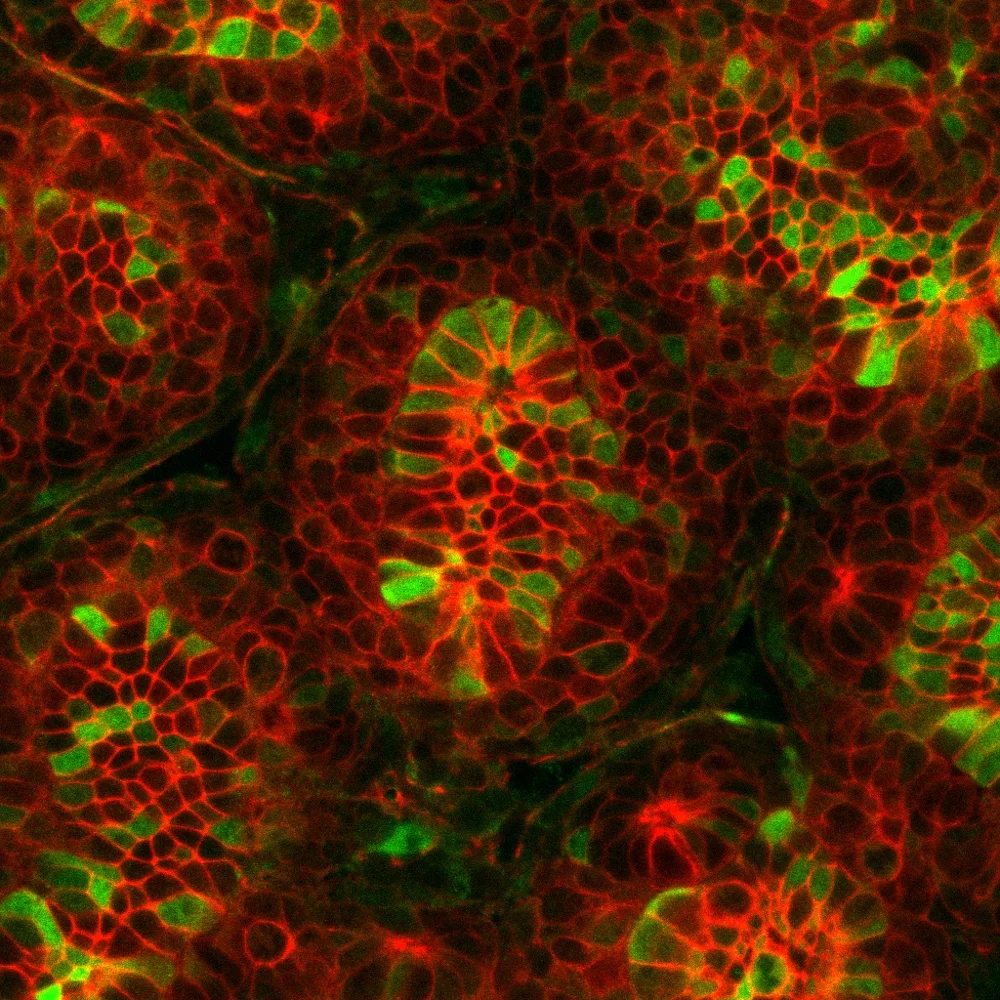
Microscopy from the laboratory